You can sell silver jewellery online from home in India by buying 925 pieces from a wholesaler and saying exactly what each piece is made of. A pair of 925 silver studs that costs ₹450 at wholesale in Jaipur can sell for ₹1,000, and it weighs a few grams. Hallmarking is voluntary for silver, but a newly hallmarked piece carries a six-character code that a buyer can check on their phone. The thing to get right is the metal, because a lot of what is sold as silver is plated brass, German silver or a low-purity mix. This guide covers the metal, hallmarking, where to buy, costs with a worked example, the listing and shipping.
What counts as silver in a listing
Sterling silver, marked 925, is 92.5% silver, and the rest is usually copper. The Bureau of Indian Standards (BIS) hallmarks silver in seven grades: 800, 835, 925, 958, 970, 990 and 999. Each number is the parts of silver in a thousand. Two grades, 925 and 800, made up nearly 90% of the pieces hallmarked in the first three months after the mark changed in September 2025, and most of the payals were 800.
Other things are sold under the word silver too. Silver-plated jewellery is a cheaper metal with a thin coat of silver on top. German silver is an alloy of copper, nickel and zinc with no silver in it at all. Oxidised is a darkened finish, not a metal. When we looked through the oxidised jewellery category on IndiaMART, the wholesale directory, in September 2026, most of the 28 listings named brass, an alloy or German silver, and one was 925. Wrong labels turn up even among sterling silver listings: we found studs listed as sterling silver whose own details said brass.
Many payal listings from Rajkot, Agra and Mathura give the purity as a percentage, which some sellers call touch. The purities we saw ran from 26% to 81%, and a few listings were 92.5%. A 65 touch payal can be sold honestly as 65% silver. It is not 925, and it cannot be hallmarked, because the lowest BIS grade is 800. Calling plated or alloy jewellery silver misleads the buyer, who can fairly send it back. If that is what you stock, sell it for what it is, as selling imitation jewellery online describes.
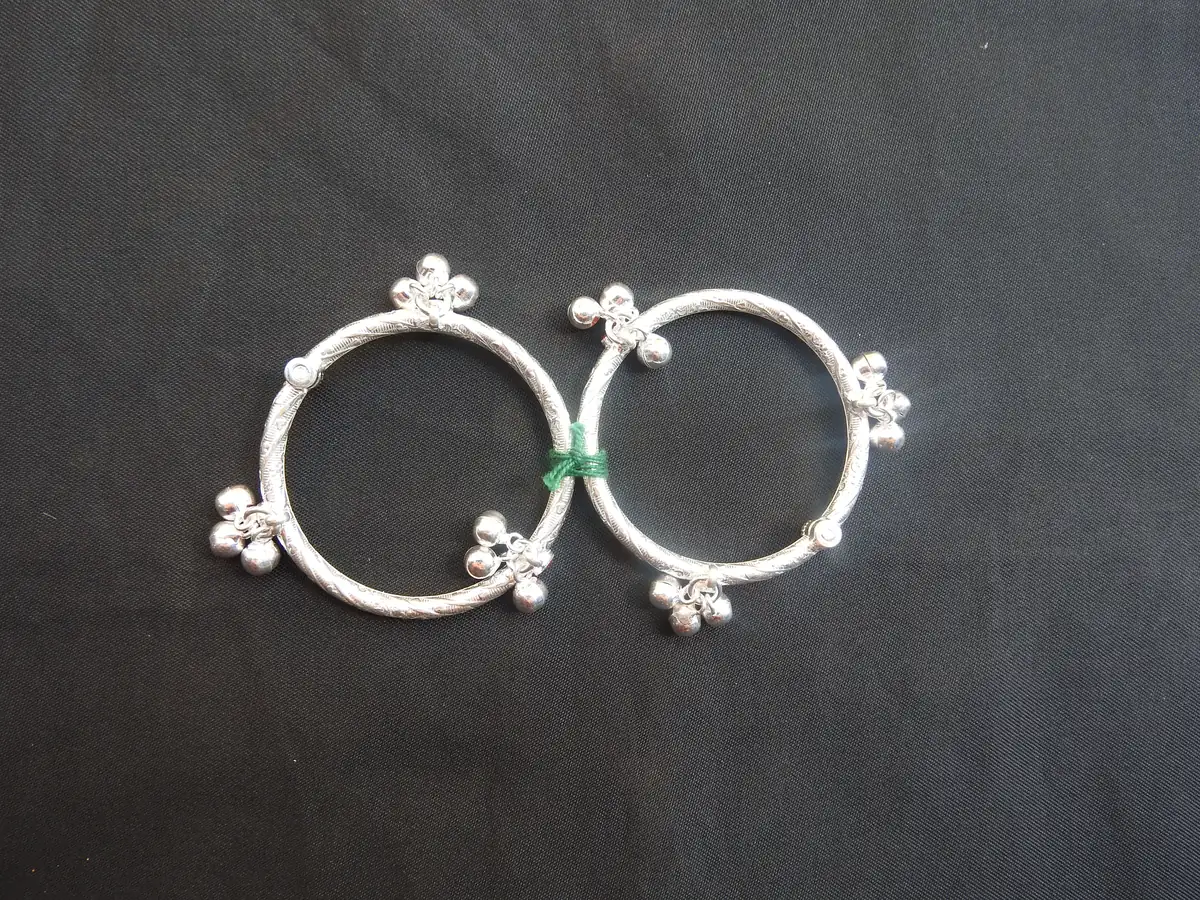 Photo: Yercaud-elango, CC BY 4.0, Wikimedia Commons.
Is hallmarking compulsory for silver jewellery?
No. Silver hallmarking has been voluntary since October 2005, and it still is. The government orders that make hallmarking compulsory cover only gold, in the districts they list. BIS's director general told PTI in June 2026 that silver hallmarking will be made compulsory gradually, so check bis.gov.in before you buy stock in bulk.
What changed on 1 September 2025 is the mark. A silver hallmark now has three parts: the BIS mark with the word SILVER, the grade, and a six-character HUID, short for hallmarking unique identification. Every piece that is hallmarked must carry one. A buyer types the HUID into the free BIS Care app and sees the purity, the kind of piece and the jeweller who had it hallmarked. Older hallmarked stock carries a four-part mark with no HUID.
To sell hallmarked silver, register with BIS first. BIS says anyone who sells hallmarked gold or silver has to register, a retailer included. Registration is online, free and instant, and it is valid for life. Only a registered jeweller can send pieces to a hallmarking centre. The centre charges ₹35 a piece, with a minimum of ₹150 a batch, plus tax, and each earring of a pair counts as a piece with its own HUID. Careful buyers run the checks in how to check an online seller is genuine, and a hallmark they can look up themselves is one more reason to trust you.
Where to buy silver jewellery at wholesale
For 925 earrings and pendants, start with Jaipur. Of the 28 sterling silver earring listings we looked at on IndiaMART, about three in four were from Jaipur, many of them set with stones. For payals, Rajkot had the most listings, 13 of the 28 in the anklet category, and Jaipur, Agra and Delhi had a few each. Delhi, Mumbai, Thane and Surat have sellers of 925 pieces too.
Silver filigree has two registered GI tags: Cuttack Rupa Tarakasi from Odisha, registered in 2023-24, and Silver Filigree of Karimnagar from Telangana, registered in 2007-08. A listing that uses either name should be for a piece made there.
Payals are often priced by the gram or the kilo, and earrings mostly by the pair. Before you pay, ask for the purity and the weight of each piece in writing, and whether it is hallmarked.
What silver jewellery costs and what you can earn
At wholesale in September 2026, simple 925 earrings with a small stone were listed at about ₹350 to ₹1,000 a pair. Payals of 92.5% silver were listed at ₹105 to ₹230 a gram, so a 40-gram bridal pair at the top of that range comes to ₹9,200. Prices differ that much between sellers, and a listed price can be old, so ask a few for a fresh quote before you order.
On the retail side, 49 of the 60 listings for 925 silver studs we checked on Amazon were priced at ₹450 to ₹1,800. GIVA, a silver jewellery brand, starts its studs at ₹899 on its own site. Every one of those Amazon listings showed an MRP above the price, some four times higher, so price against the selling prices, not the MRP.
Here is one pair all the way through. You buy 925 silver studs with a small stone for ₹450 from a Jaipur wholesaler. A zip bag, a small box and a padded envelope cost about ₹25. You send the pair by Speed Post to another state, insured for ₹1,000. The Speed Post rate for other states is ₹90 plus GST, and the insurance fee is ₹16, so the parcel costs about ₹125 in all. Your cost is ₹600. Sell the pair for ₹1,000 and you keep about ₹400. To a buyer in your own city the postage is ₹28, and you keep about ₹475. Hallmarking adds ₹70 plus tax a pair, as long as you send at least three pairs at a time to clear the ₹150 minimum.
What to write in the listing
Put the facts that decide a silver price in the listing: the metal and grade, the weight in grams, the hallmark, any plating, the stones and the size. Many 925 pieces are rhodium plated, and GIVA says most of its silver is coated with rhodium for a lasting shine, so say whether yours is. Photograph each piece in daylight on a plain background, and once on a hand or an ear so the buyer can judge the size. A full listing reads like this:
925 sterling silver stud earrings with a 4 mm white cubic zirconia, 1 pair. Weight 2.5 g for the pair. BIS hallmarked, SILVER 925, with its own HUID on each earring, which you can check in the BIS Care app. Rhodium plated. 8 mm across, with a push-back lock. Comes in a zip bag and a box. Keep it in the zip bag, away from perfume, soap and damp, so it keeps its shine.
If a piece is not hallmarked, say so. If it is 800 or 65 touch, say that too.
How to ship silver jewellery
A pair of studs in a padded envelope stays in the smallest courier slab, half a kilo, as courier rates for small sellers explains. The difficulty is that silver is valuable, and couriers treat valuables differently.
Shiprocket, a courier booking app, lists "precious stones, gems and jewelry" as restricted items on its page of products you cannot ship through it. It warns of penalties and says it is not liable for their loss or theft, and its parcel insurance leaves out jewellery made of gold or silver. Check the rules of whichever courier or app you use before you book.
India Post carries silver if it is insured. Under the Post Office Regulations, 2024, a parcel with silver or jewellery in it must be insured for its actual value, and you write that value on the parcel when you book it. For a Speed Post parcel the insurance fee is ₹4 plus 1.5% of the value above ₹200, which is the ₹16 in the example above. Wrap each piece in its own zip bag, put it in a small box so it cannot bend, and send the buyer the tracking number the day it ships.
GST and labels
Silver jewellery is HSN 7113 and carries 3% GST, the same rate as imitation jewellery, under the rate notification in force since 22 September 2025. GST rates and HSN codes covers when the code goes on an invoice. Selling within your own state under the yearly limit needs only a free enrolment number, and shipping to other states needs registration, as GST for online sellers explains. The pouch or box needs the same label as any packed product, which our post on MRP and label rules for packed products lists. The same rules ask anyone who packs goods for sale to register as a packer with the state's Legal Metrology department within 90 days of starting, for a fee of ₹500.
Selling on Sagazo
Selling on Sagazo is free. There is no commission and no listing fee, so a pair of studs you sell for ₹1,000 pays you ₹1,000. Ship silver orders yourself, as in the example above. Our shipping partner lists jewellery among the items it restricts, so use a courier or India Post service that accepts silver, and declare its value. Your pieces get their own shop page, and they appear under jewellery on Sagazo and in the feed, where a good photo reaches buyers beyond your own contacts.
Tell us about your shop on the become a seller page and we will help you get set up.
Once your shop is open, the help centre explains the product details table, where a line such as Purity: 925 becomes a row on the product page, and product photos that sell.
The rules and rates here are as of September 2026, and they change. Check bis.gov.in and indiapost.gov.in before you rely on them.