A handloom saree is woven on a loom the weaver works by hand and foot, and a powerloom saree on a loom driven by power. In a listing photo the two can look alike. The surest check is a label you can verify: the Handloom Mark, whose QR code shows you the weaver, or the India Handloom Brand, whose registration number you can look up. After that, the back of the saree and the price are useful clues, though neither proves anything on its own. This post explains the difference, the law that keeps certain sarees for handlooms, the two labels, the signs you can check yourself, and what to ask a seller before you pay.
What is the difference between a handloom and a powerloom?
The law puts it simply. The Handlooms (Reservation of Articles for Production) Act, 1985 defines a powerloom as "a loom which is worked by power", and a handloom as any loom other than a powerloom. On a pit loom, a common kind of handloom for sarees, the weaver passes the shuttle across by hand and works the treadles with the feet.
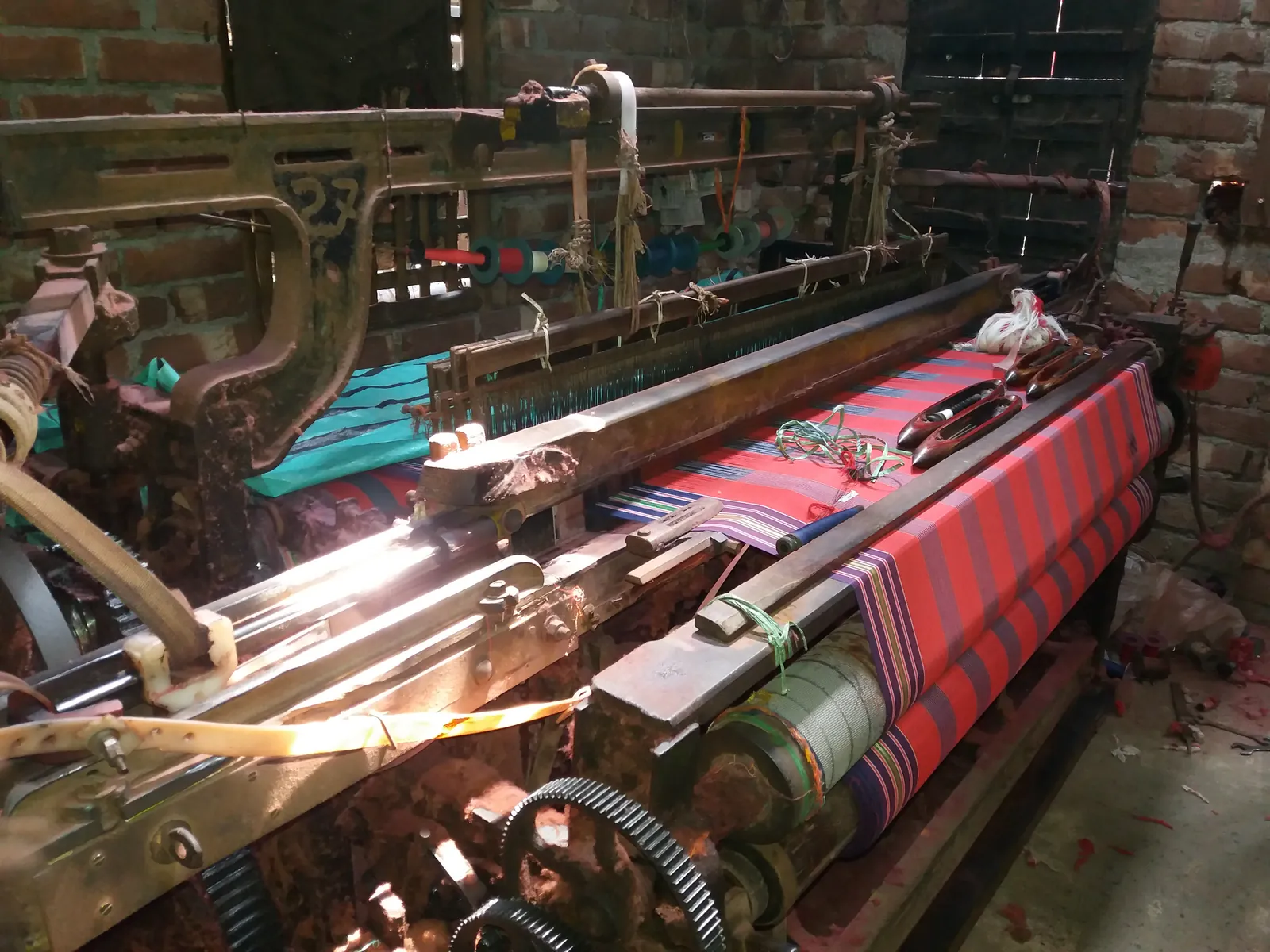 Photo: Tarunsamanta, CC BY-SA 4.0, Wikimedia Commons.
A handloom can still carry a jacquard or a dobby, the attachments that lift threads to make a pattern. The India Handloom Brand's product sheets describe Banarasi brocades woven on handloom jacquards, and Kanchipuram sarees woven with two or three jacquards. So a listing that says jacquard is not telling you the saree came off a powerloom.
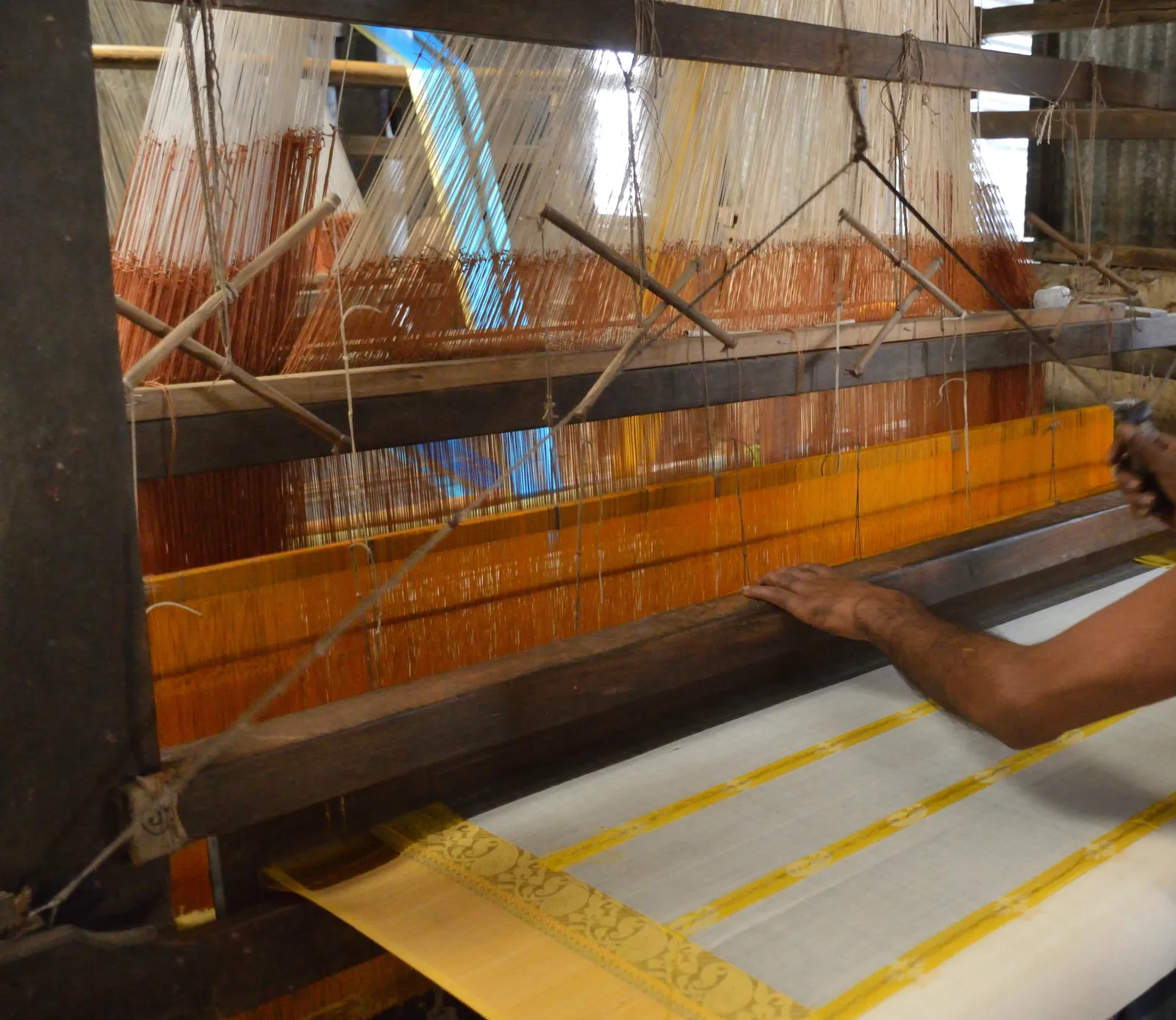 Photo: Biswarup Ganguly, CC BY 3.0, Wikimedia Commons (cropped).
Why the difference matters
Handloom weaving is slow, skilled work, and a lot of people live by it. The fourth All India Handloom Census, 2019-20, counted 35.22 lakh handloom workers in 31.44 lakh households, 26.74 lakh of them weavers, and more than seven in ten of them women. The Development Commissioner for Handlooms puts the sector's share of India's textile production at about 15%.
Some weaves take far longer than others. The India Handloom Brand calls the Paithani way of weaving, colour by colour in short threads, the most labour-intensive and time-consuming kind. A traditional Kanchipuram with a solid contrast border takes two weavers at the loom. That work is what you pay for in a handloom saree. The government's stated reason for the 1985 Act is to protect handloom weavers' livelihood from the powerloom and mill sector.
Which products are reserved for handlooms?
The Act lets the central government reserve articles for handlooms. Once an article is reserved, it may not be produced on any loom other than a handloom. In plain words, powerlooms and mills are not allowed to make it. The first list had 22 articles. The order in force today, S.O. 2160 of 3 September 2008, reserves 11, each with technical specifications:
- Saree
- Dhoti
- Towel, gamcha and angavastram
- Lungi
- Khes, bedsheet, bedcover, counterpane, furnishing (including tapestry, upholstery)
- Jamakkalam, durry or durret
- Dress material
- Barrack blankets, kambal or kamblies
- Shawl, loi, muffler, pankhi and similar
- Woollen tweed
- Chaddar, mekhala or phanek
For sarees, the order covers cotton and silk sarees, and blends with up to 45% man-made fibre by weight. It covers them when they have extra-thread designs in the border, pallu or body, a solid woven border, or tie-and-dyed yarn. Crepe, chiffon, chinon, georgette and cotton voile sarees are among those left out, so a powerloom georgette saree is outside the reservation.
Central and state enforcement teams inspect powerlooms for reserved articles. From 2014-15 to June 2025 they carried out 34.73 lakh powerloom inspections, and 813 FIRs were filed, with 664 convictions. The Jan Vishwas (Amendment of Provisions) Act, 2026 changed the penalty from 16 June 2026. Making a reserved article on a powerloom can now bring up to three months in jail, a fine of ₹10,000 to ₹25,000 per loom, or both. The cloth and the loom can also be forfeited.
What is the Handloom Mark?
The Handloom Mark is a label for handwoven products. It was launched in 2006 and is run by the Textiles Committee, a body under the Ministry of Textiles, for the Development Commissioner for Handlooms. The Development Commissioner describes it as a guarantee to the buyer that the product is genuinely handwoven "and not a power loom or mill made product". Weavers, cooperatives and other handloom producers can register, and each is registered only after an on-site check.
The logo, designed by the National Institute of Design, shows warp and weft threads interlocking, and it is registered as a certification trade mark that only registered users may use. It comes on a polyester taffeta label with a unique QR code. Scan the code with any QR reader, and a genuine label shows you the weaver's details. The Textiles Committee says more than 13 crore products have been tagged with these labels.
What is the India Handloom Brand?
The India Handloom Brand is about quality as well as the loom. Prime Minister Narendra Modi launched it in Chennai on 7 August 2015, the first National Handloom Day. It is for high-quality handloom products "with zero defect and zero effect on environment". The Development Commissioner lists its features: 100% handloom, made of 100% natural fibres, fast colours, skin-friendly dyes and socially compliant production.
A registration follows a laboratory test of a sample and a visit to the maker's premises, and it lasts three years. Each India Handloom Brand label must carry the maker's registration number. The brand's site, indiahandloombrand.gov.in, keeps a directory of registered users to check that number against.
For silk sarees there is also the Silk Mark, which vouches for the purity of the silk and has a label number you can check at silkmarkindia.com. It answers a different question from the two handloom labels.
Signs you can check yourself
No single sign on the cloth proves handloom. The India Handloom Brand's product sheets list, weave by weave, how to tell a genuine one from a copy, and types of sarees in India goes through those checks saree by saree.
Turn the saree over, because many of the checks are on the back. A woven ikat keeps its colours there while a printed copy is paler, and the back of a jamdani shows each design thread turning round where its motif ends.
Look closely where a saree's parts meet, such as the loops that attach an Ilkal's pallu or the trimmed ends where a Kanchipuram's contrast pallu joins the body. The sheets give all of these as signs of a genuine weave, not as proof of the loom, so ask for the label as well.
Feel it, but do not decide by it. The sheets describe some handloom cottons, like Mangalagiri, as soft because they have no starch finish, and others, like Shantipur, as stiff from a starch finish. Small irregularities in the weave are a weak clue too. None of the brand's saree sheets we read lists them as a sign, and a fine handloom such as Mangalagiri is described as more compact than similar cotton sarees.
What the price tells you
Our guide to what to sell in the wedding season found handloom Banarasis from Varanasi at ₹1,750 to ₹11,000, against ₹450 to ₹1,250 at wholesale for Banarasi-style sarees from Surat. So a saree sold as pure handloom Banarasi for a few hundred rupees is very unlikely to be one.
A higher price does not prove handloom. When we looked on IndiaMART in September 2026, several cheap Banarasi listings from Surat said in their own details that the pattern was printed. So did a Surat listing at ₹1,750, the bottom of the handloom band, and a Varanasi listing at ₹1,510.
What to ask a seller before you pay
- Where was it woven, and in which town?
- Is it handloom or powerloom, and will you say so in the listing?
- Does it carry a Handloom Mark or India Handloom Brand label? Send a photo of the label with the QR code or registration number.
- If it is sold under a GI name, is the weaver a registered authorised user? What a GI tag is explains how to check.
- Can you send photos of the back of the border and of the pallu?
- Can I return it if it turns out not to be handloom?
A seller who answers all of these without fuss is showing you what they have. The checks worth making on the seller are in how to tell if an online seller is genuine.
Selling on Sagazo
Weavers and shops that sell handloom sarees can list them on Sagazo, with no commission and no listing fee. Say handloom only when it is, put the label number in the listing, and photograph the back of the border, so a buyer can check the claim for themselves.
Tell us about your shop on the become a seller page and we will help you get set up.
Once your shop is open, the help centre explains how to write a product description and the product details table, where the loom and a label number can each have a line.
Buying a handloom saree on Sagazo
The sarees on Sagazo come from different sellers, and we do not test how a saree was woven, so the checks in this guide are yours to make. Ask for the label number and a photo of the back of the border before you buy.