If you are registered for GST and sell taxable goods, an online order needs a tax invoice, made before the parcel leaves or as it leaves. The CGST Rules list what goes on it, including your GSTIN, an invoice number, the HSN code, the tax and, for a buyer in another state, the place of supply. If you sell nil-rated goods, or pay tax under the composition scheme, you issue a bill of supply instead, which shows no tax. If you sell on the free enrolment number, you are not registered, so you cannot charge GST or issue a tax invoice. Consumer law still counts not issuing a bill among unfair trade practices, so give a simple one. This post takes each case in turn, with one order worked through.
Which document do you need?
It depends on your registration and on what you sell.
- Registered, selling goods that carry GST: a tax invoice.
- Registered, selling nil-rated or exempt goods, or paying tax under the composition scheme: a bill of supply.
- Registered, selling both kinds to an unregistered buyer in one order: one invoice-cum-bill of supply can cover both.
- Not registered, selling on an enrolment number: no GST document, only a simple bill.
If you are not sure which you are, our post on whether you need GST to sell online sets out the rules, and how to register for GST online goes through registration step by step.
The free invoice maker asks which of these you are and makes that document as a PDF, with the tax worked out. If you would rather use a billing app, which billing apps are free for small businesses in India covers the catch in each.
What a GST tax invoice must show
Rule 46 of the CGST Rules sets out the details. For an online order of goods, the invoice shows:
- Your name, address and GSTIN.
- An invoice number and the date.
- The buyer's name and address, and their GSTIN if they are registered.
- The HSN code of each item.
- A description, the quantity and the unit, such as pieces.
- The total value, and the taxable value after any discount.
- The rate and amount of tax, as central and state tax, or as integrated tax.
- For a sale to another state, the place of supply with the state's name, and the delivery address if it is different.
- Whether the tax is payable on reverse charge.
- Your signature or digital signature.
The invoice number has its own rule. It runs in sequence and has up to 16 characters: letters, numbers, hyphens and slashes. It must not repeat within a financial year, and you can keep more than one series. A number such as AD/2026-27/0042 fits.
For the HSN code, a seller with sales up to ₹5 crore in the last financial year prints four digits on invoices to registered buyers, and may leave the code off invoices to unregistered buyers. Above ₹5 crore it is six digits. HSN codes and GST rates has the codes for common products.
When the buyer is not registered
When the buyer is a household rather than a registered business, the rules ask for less. The buyer's name and address, the delivery address, and the state's name and code must be on the invoice when the taxable value is ₹50,000 or more. Below that, they are required only if the buyer asks. Put the delivery address on anyway, because for a household buyer the address on the invoice decides the place of supply.
Very small sales get a further relief. If a sale to an unregistered buyer is below ₹200 and the buyer does not want an invoice, you need not issue one. You then make one consolidated invoice at the end of each day for all such sales.
Which GST goes on the invoice?
For goods sent to a registered business, the place of supply is where the delivery ends. For a sale to a household, it is the buyer's address written on the invoice, and the state's name alone counts as that address. If the invoice shows a billing address and a different delivery address, a June 2024 circular from CBIC, the tax board, says the delivery address decides. With no address on the invoice at all, the place of supply is your own state.
If the place of supply is in your own state, the sale is intra-state and the invoice shows central tax and state tax, CGST and SGST. If it is in another state, the sale is inter-state and the invoice shows integrated tax, IGST. On goods taxed at 5%, that is 2.5% CGST plus 2.5% SGST, or 5% IGST.
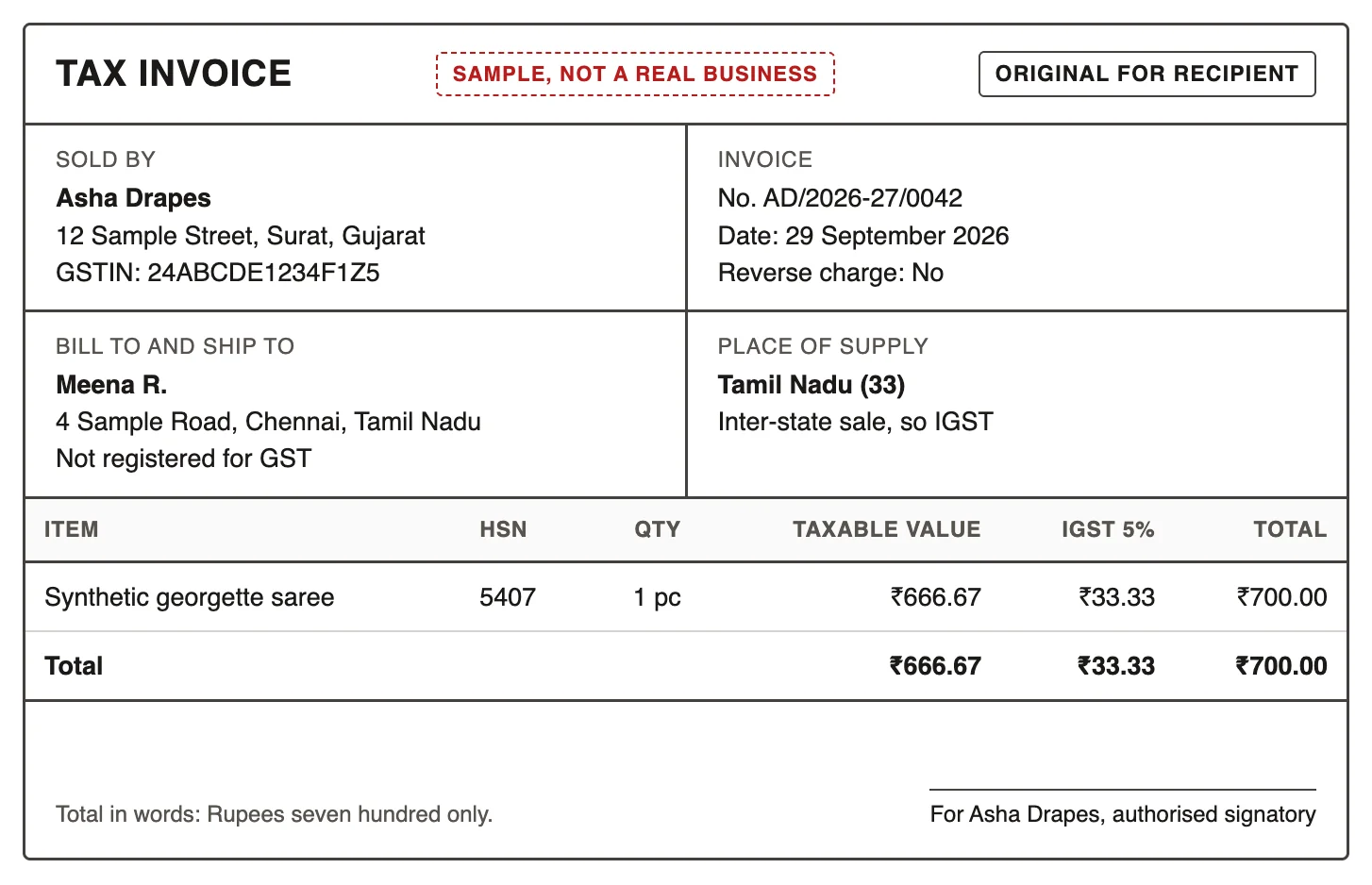
Here is one saree all the way through. A registered seller in Surat sells a synthetic georgette saree, HSN 5407, taxed at 5% at any price, to a buyer in Chennai for ₹700 including GST. With the Chennai address on the invoice, the place of supply is Tamil Nadu, so the sale is inter-state and the tax is IGST. The taxable value is ₹700 divided by 1.05, which is ₹666.67, and IGST at 5% is ₹33.33.
The invoice carries the seller's name, address and GSTIN, the number AD/2026-27/0042 and the date. It names the buyer and the Chennai delivery address, with Tamil Nadu as the place of supply. The line reads HSN 5407, one piece, taxable value ₹666.67, IGST at 5% ₹33.33, total ₹700. Sent to a buyer in Ahmedabad instead, the same saree would show CGST and SGST at 2.5% each in place of the IGST line.
Timing, copies and signature
Make the invoice before the goods leave for the buyer, or as they leave. For goods, the rules ask for three copies. The one marked ORIGINAL FOR RECIPIENT goes to the buyer, DUPLICATE FOR TRANSPORTER is for whoever carries the goods, and TRIPLICATE FOR SUPPLIER stays with you. A paper invoice needs your signature, and one issued electronically under the IT Act does not.
When you issue a bill of supply instead
A bill of supply replaces the tax invoice when you sell exempt goods, which under GST include nil-rated ones, or when you pay tax under the composition scheme. It carries your name, address and GSTIN, a serial number and the date, the buyer's details if they are registered, the HSN code, a description, the value and a signature. It shows no tax.
A composition seller must print these words at the top of every bill of supply: "composition taxable person, not eligible to collect tax on supplies". The same seller shows "composition taxable person" on the signboard at the place of business.
One order can mix the two kinds. Clay diyas carry no GST and candles carry 5%, so a registered seller selling both to an unregistered buyer can issue one invoice-cum-bill of supply with the details both documents need.
If you sell on the enrolment number
A seller on the free enrolment number is not registered. The GST law says a person who is not registered must not collect any amount by way of tax, so you cannot put GST on your bill or issue a tax invoice. Getting a GST enrolment number covers this route.
Consumer law still has a say. The Consumer Protection Act, 2019 lists, among unfair trade practices, "not issuing bill or cash memo or receipt for the goods sold or services rendered in such manner as may be prescribed". The next clause covers refusing to take back defective goods and refund the money within the period stated on the bill, or within 30 days if the bill states none. So a bill is worth giving even when GST does not ask for one. It is the buyer's record of the purchase, and it is where your return terms go.
As good practice, a simple bill carries your shop's name, address and phone number, a bill number and the date, and the buyer's name and delivery address. Below those go each item with its quantity and price, the total, and your return or replacement terms. Do not show any GST on it.
E-invoicing is only for larger businesses
E-invoicing means each invoice is registered on the government's portal, which returns an Invoice Reference Number and a QR code to print on it. It covers invoices to registered businesses, and only for sellers whose turnover in any year from 2017-18 onwards was more than ₹5 crore, a limit in force since 1 August 2023. A home seller below that limit makes invoices the ordinary way.
How long to keep your invoices
A registered seller has to keep true accounts of sales and purchases, with the invoices and bills of supply behind them, at the principal place of business. They have to be kept for 72 months, six years, from the due date of the annual return for the year they belong to. Records tied to an appeal or an investigation are kept until a year after it ends, if that is later.
What Sagazo gives you for your records
Sagazo does not make an invoice for each order by itself, but it keeps most of the details you need to make one. Each order has its own page in your shop console, with the order number, the items with their quantity and price, the total, and the name, phone number and address the parcel goes to. Type them into the invoice maker and it makes the bill; when you are signed in as a seller, it fills in your shop's details for you. Export CSV on the Orders page downloads all your orders as a spreadsheet, one row per order, with the order number, date, buyer, items, quantity and amount. That is useful for your accounts and, if you are registered, your returns.
Selling on Sagazo
Selling on Sagazo is free. There is no commission and no listing fee, so Sagazo keeps nothing from the ₹700 saree above. If you are registered, 0.5% TCS is deducted on payments made through Sagazo and deposited against your GSTIN, where you claim it back.
Tell us about your shop on the become a seller page and we will help you get set up.
Once your shop is open, the help centre shows which GST number to enter in your shop settings.
This post is general information, not tax advice. Rules change, so check gst.gov.in or ask a CA for your own case.