We built Sagazo for India first because the apps most Indians spend their day in were designed for somebody else. India is WhatsApp's largest market, with more than 50 crore users, and WhatsApp is designed in California. Pinterest, which many Indians use to plan weddings and kitchens, reports its users by region and gives no figure for India. That is why a small team in India decided to build a social app starting from how people here already share and buy, instead of adapting one built for somewhere else. This post explains what that decision changed in the product, what it did not mean, and where we are still small.
The apps India uses were designed somewhere else
Most social apps arrive in India after they have grown up elsewhere, and they arrive with their habits. Sign-in wants an email address, when most people here have a phone number and little else. Shopping features assume a warehouse and a card, when most small sellers here pack parcels at home and most buyers pay with UPI. Groups are chat streams, when an apartment building or a college batch needs a notice board where a post stays put.
India has tried to build its own before. After the government banned TikTok and 58 other Chinese apps in June 2020, a wave of Indian apps launched to take their place, and many of them are gone. Koo, which was meant to be India's Twitter, shut in July 2024. Others disappeared from the app stores without a notice. Social media apps made in India goes through which ones survived. The ones that did mostly did one thing well: short video in Indian languages, community groups, stories to read. None of the ones we used put the post, the shop and the group in one place, and that is the gap we saw.
What "India first" changed in the product
You sign in with a phone number and a one-time code, with no email address to give. A code on your phone is how nearly every Indian service already works, so that is how Sagazo works, and you set a password once so that the next login needs no code.
Sellers pack their own orders. The big marketplaces here are built around warehouses, and a woman selling twenty sarees a month from home does not fit a warehouse. On Sagazo she lists the saree and a buyer orders it. She can post the parcel herself, and then the courier is her cost, or have us book the courier through our shipping partner, and then the buyer pays the quoted delivery charge at checkout. Either way the parcel comes from a person, not a fulfilment centre.
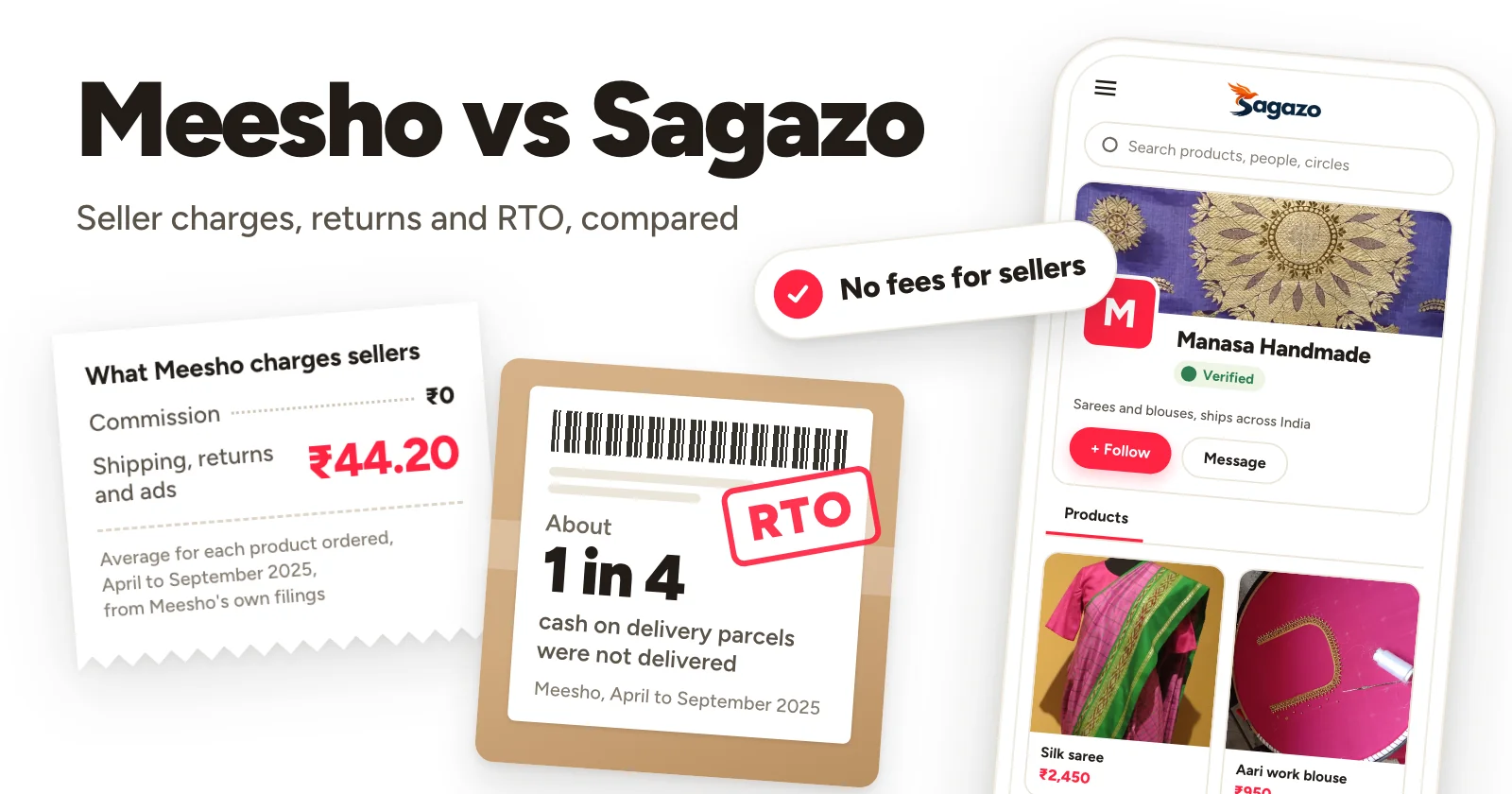
Selling is free. We take no commission and no listing fee, so the price a seller sets is the price she keeps. Most Indian home sellers already sell on WhatsApp status and pay nobody a cut. We did not think a shop page and a cart should cost them the ₹30 to ₹125 that comes off a ₹500 sale on a big marketplace. The amount depends on the platform, and on whether it carries the parcel. What marketplaces really charge sellers in India has the comparison, and selling on Sagazo without commission explains that the app does not make money yet.
Groups have a feed. Many buildings, batches and hobby groups in India run on a WhatsApp group, and a WhatsApp group is bad at keeping things. A Circle has a feed where posts stay, a member list, and a group chat for the rest. Our post on Circles on Sagazo explains them.
And it is one app for the whole country. Sagazo is not a city app. A seller in Madurai sells to a buyer in Guwahati, and the feed is what people across India are posting, not just what your own town is posting.
What it did not mean
Building for India first did not mean pretending good ideas stop at the border. The feed on Sagazo is a grid of photos at their natural heights, the layout Pinterest made famous, because it is the best way anyone has found to scroll pictures on a phone. The idea that a product photo can be a post, and a post can be a shop, came from watching how people already sell in group chats here and how the big Chinese apps merged the feed and the shop years ago. We took what worked and built it around Indian habits.
It also did not mean putting a flag on the app icon and calling it Indian. We are asking people to use Sagazo because sign-in takes ten seconds, the seller is a person you can message, and the group keeps its posts. If those things are not true for you, the origin of the app does not matter.
Where we are still small
Sagazo is new. The feed is what people posted this week, not ten years of saved ideas, and on a quiet day you will reach the end of it. The shop is small, and a category you care about may have a handful of sellers or none yet. Sagazo's website is in English, Hindi, Telugu, Tamil and Kannada, which still leaves out many of India's languages, and we know it. Videos came after photos, and there are still no stories, because we started with the photo and the written post and wanted to get those right first. And we are a small team, so when something does not work the way you expected, it may take us a little while to fix it, though a message to us reaches a person.
What we would ask is that you judge the app on those terms rather than against the ones with a decade behind them. Try posting something, look at what a seller near you is making, or start a Circle for a group you already run somewhere else. If it does not earn a place on your phone, it should not have one.
We would rather you look than take our word for it. The feed is open to read without an account.
Selling on Sagazo
If you make or sell something from home, you can sell it here. Listing is free, and a ₹700 saree pays you ₹700. You can ship each order yourself, and then the courier is your cost, or have us book the courier through our shipping partner, and then the buyer pays the quoted delivery charge at checkout. Your products appear in the shop and the feed, where a good photo reaches buyers beyond your own contacts.
Tell us about your shop on the become a seller page and we will help you get set up.
If you sell here, the help centre for sellers covers the shop console one task at a time: adding products, sending orders, getting paid.