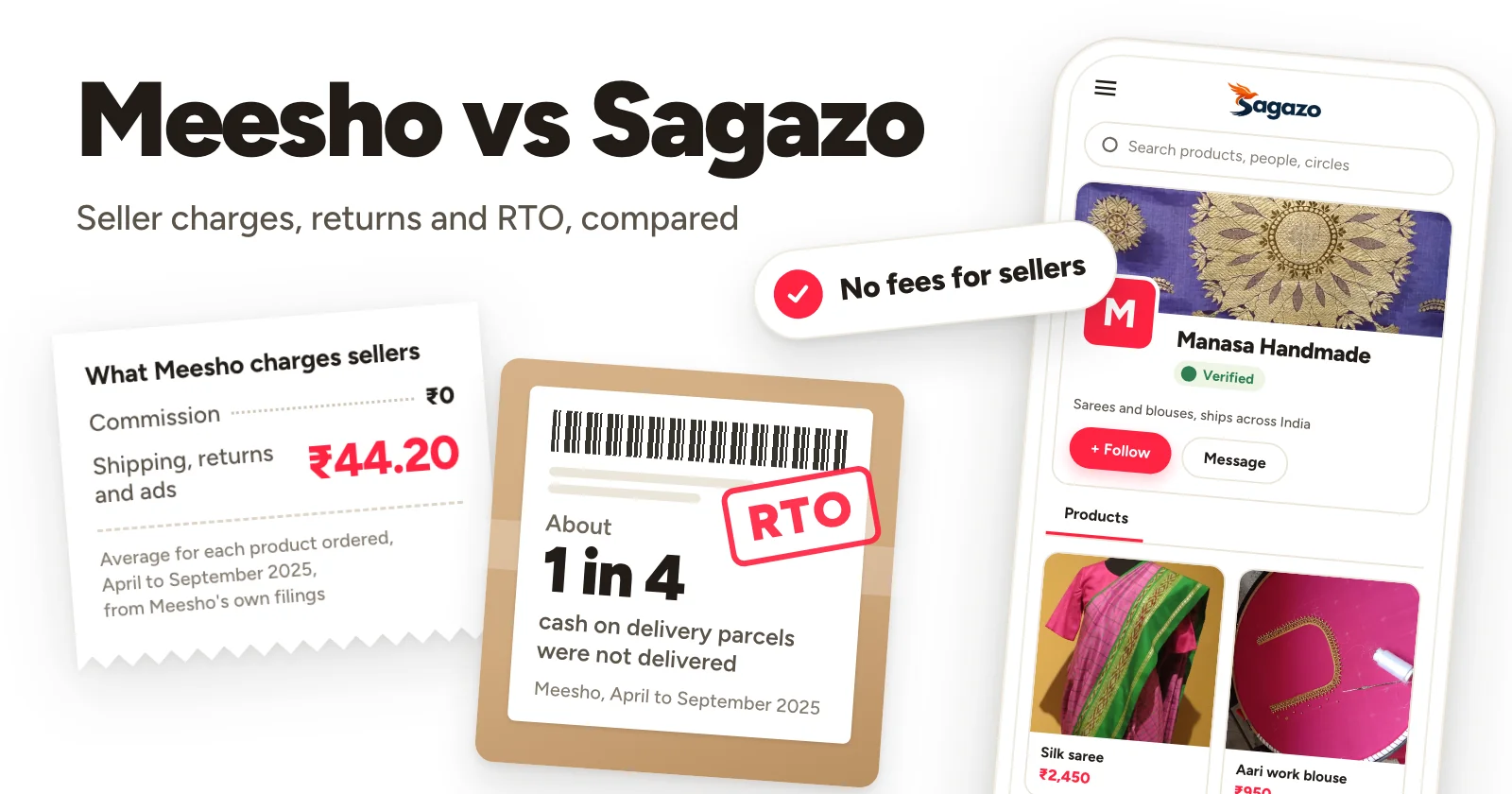
Neither Meesho nor Sagazo takes commission from small sellers, but what each costs you is very different. On Meesho you pay its shipping charge on every delivered order, a return shipping fee when a buyer sends a product back, and any ads you run. By Meesho's own figures, those charges came to ₹44.20 for every product ordered in April to September 2025. In the same months, about one in four of its cash on delivery parcels was not delivered. Sagazo charges sellers nothing. A shop on Sagazo may post the parcel itself, and then the courier is its cost, or have Sagazo book the courier, and then the buyer pays the quoted delivery charge at checkout. Sagazo takes online payment only, so a buyer pays before the parcel leaves.
The other big difference is reach. Meesho is one of India's biggest shopping apps, with 274 million buyers in the year to June 2026 and its own delivery network. Sagazo is a new social commerce app where every shop gets its own page, products appear in a feed of posts, and a seller can run a community for their buyers. Sagazo is still small. If you need orders this month, Meesho has the buyers. If you want buyers who know your shop by name and come back to it, Sagazo is made for that. You can also sell on both.
This post goes through both apps feature by feature, first for sellers and then for buyers, with the good and bad side of each.
Meesho vs Sagazo at a glance
| Meesho | Sagazo | |
|---|---|---|
| What it is | A marketplace app for low-priced products | A social app with a feed, shops and community groups |
| Size | 274 million buyers and 1.04 million sellers (year to June 2026) | New and small |
| Commission | 0% on the main marketplace | 0% |
| Other charges to sellers | Meesho's shipping charge, a return shipping fee, ads if you want them | None |
| Who delivers | Meesho chooses the courier | The seller, or a courier Sagazo books |
| Cash on delivery | Yes | No, online payment only |
| How sellers are paid | To their bank account, minus fees, by the eighth working day after delivery | To their bank account, with no commission taken out |
| A shop page buyers can follow | Yes, with its rating and followers | Yes, with who runs it and a Message button |
| Public reviews | Ratings and reviews on product pages | Not yet; a buyer's rating goes to the shop |
| Returns for buyers | 7 days | No returns policy yet |
| Languages | 10 | 5 (English, Hindi, Telugu, Tamil, Kannada) |
What is Meesho?
Meesho started in 2015 as an online shop front for small sellers, then became a reselling app. People shared suppliers' products with their contacts on WhatsApp and earned a margin, the model we explain in starting a reselling business from home. In 2021 Meesho began taking orders from buyers directly, and in August 2021 it stopped charging sellers commission.
In the year to June 2026, 274 million people bought on Meesho and 1.04 million sellers received orders. In the year to March 2026, 88% of its buyers lived outside India's eight biggest cities. Prices are low: half of the clothes sold in April to September 2025 cost under ₹301, and the average product ordered cost ₹265.50. Meesho delivers about half of its orders through its own network, Valmo. It listed on the stock market in December 2025.
What is Sagazo?
Sagazo is a social commerce app built in India. It has a feed where people post photos, text and polls, a shop where sellers list what they make or stock, and community groups called Circles. If you are new to it, our post on what Sagazo is explains the app in more detail.
Every shop on Sagazo has its own page with its own link, like sagazo.com/shop/your-shop-name. The page shows your banner, a line about your shop, who runs it, your products and how many people follow it. Sagazo works in English, Hindi, Telugu, Tamil and Kannada, and runs in the browser on any phone or computer.
Selling on Meesho vs Sagazo
Can you sell on Meesho or Sagazo without GST?
On Meesho you need a mobile number, an email address, a bank account, and either a GST number (GSTIN) or a GST enrolment number if you are not registered for GST. If you have a GSTIN, the bank account must be in the business name on it, and your pickup address must be in its state. A seller on an enrolment number sells only inside their own state. Meesho stops their sales once their total sales, on Meesho and elsewhere, pass ₹40 lakh a year (₹20 lakh in the north-eastern states).
On Sagazo you sign in with your phone number and fill in the shop form: your shop's name, category, phone, email, pincode and address. Add a GST number if you have one, to sell anywhere in India, or the free GST enrolment number to sell inside your own state. Our team then verifies your shop with a call or a message, within 24 hours, before its products show to buyers.
How much do Meesho and Sagazo charge sellers?
Meesho takes no commission on its main marketplace, and listing is free. Brands in its Meesho Mall section do pay a commission. Meesho earns from fees for its services instead:
- A shipping charge on every delivered order, taken from your payout. It depends on the weight, the delivery zone and how the buyer pays, with GST on top. Meesho shows the rate card only inside the supplier panel, and it raised its logistics prices in April to June 2026.
- A return shipping fee when a buyer returns or exchanges a product.
- Ads, if you want them, paid per click from a minimum budget of ₹300. Meesho says about two-thirds of the sellers who make sales also buy ads. Its supplier homepage said in August 2025 that ads were not open to sellers without a regular GSTIN.
All of it together came to ₹44.20 for every product ordered in April to September 2025, by Meesho's own figures, down from ₹51.17 in the year to March 2025. That is about a sixth of ₹265.50, the average price of a product ordered on Meesho in the same months.
Sagazo charges sellers nothing. There is no commission, no listing fee and no monthly charge, so the price you set is the price you keep. If your shop is registered for GST, the law makes every marketplace, Meesho and Sagazo included, hold back 0.5% of the sale (its value before GST) as TCS. You claim it back when you file your return. How zero commission selling works on Sagazo explains how we can afford to charge nothing.
Can you choose your own courier?
On Meesho you pack each order in plain packaging, with no branding, and Meesho's pickup agent collects it. Meesho's system chooses the courier, either Valmo or a partner, and you cannot pick your own. Meesho's seller guide says a seller caught sending a Meesho order straight to the buyer pays a ₹5,000 penalty. Orders must leave within the dispatch time you agreed, usually 2 to 3 days. On other penalties Meesho's own pages disagree. Its supplier homepage promised none for late dispatch or cancelled orders until at least August 2025, while its seller lessons list one when you cancel an order or miss the dispatch date.
On Sagazo you choose. You can post the parcel yourself, and then the courier is your cost, or have Sagazo book the courier through our shipping partner, and then the buyer pays the quoted delivery charge at checkout. Posting it yourself means you can use any courier or India Post, and our post on what couriers charge in India has the rates.
Returns and RTO: how many parcels come back?
Meesho gives buyers 7 days to return or exchange an unused product. When a buyer returns one, you pay a return shipping fee. Meesho's return rate in April to September 2025 was 7.85% of the orders it shipped.
Meesho doesn't publish an RTO rate as such, but its prospectus gives the share of parcels delivered. In the same months, about 76% of cash on delivery parcels were delivered, against about 96% of prepaid ones, so about one in four cash on delivery parcels was not delivered. A parcel that is refused at the door, or that can't be delivered, goes back to the seller. That is an RTO, return to origin. Meesho's pricing page said in 2024 that an RTO cost the seller nothing extra, and it has not said what applies in 2026. Meesho also offers sellers a paid Return and RTO Assurance programme, charged as a share of their sales.
Sagazo has not published a returns policy yet, so there is none to compare. Buyers pay online before a parcel leaves, because Sagazo has no cash on delivery.
Payment cycle: when do sellers get paid?
Meesho's payment cycle is set by its policy: it pays sellers by the eighth working day after an order is delivered, into their bank account, cash on delivery orders included. Its older seller pages said 7 days. The money arrives after the fees above are taken out.
On Sagazo, the money from each sale is settled to your bank account with no commission taken out, and when and how you get paid explains how it works.
Your shop page and your brand
On Meesho, each product page shows the shop that sells it, with the shop's rating, how many people follow it and a View Shop button, and buyers' reviews of the product. Most orders still come through Meesho's own feeds: Meesho says over 75% of its orders come from its AI-driven feeds. Your parcels go out with no branding.
On Sagazo, your shop page is yours to share. It carries your banner, your shop's name with a Verified badge once we have checked it, a line about what you make, who runs the shop, your newest products and a Message button. People can follow your shop, and you can share its link on WhatsApp or Instagram. Our Meesho alternatives for sellers post looks at why that matters when you want repeat buyers.
Getting seen
Meesho has a huge audience, so the work is standing out among similar listings. Its tools for that are ads, creators' videos (over 4 lakh sellers have opted in to work with creators), a badge for sellers who dispatch the next day, and a Trusted tag for well-rated sellers. Meesho said in 2024 that it takes products rated below 3 out of 5 out of its feed.
Sagazo's audience is small, so the work is bringing people to your shop. Your products appear in the Discover feed between people's posts, in the shop and its category pages, and in search. You can post about a product so it shows in the feed, and people who follow your profile see your posts in their Following tab. You can also start a Circle for your customers. Sagazo has no ads.
Talking to your buyers
On Meesho, a buyer gets help from Meesho's own support, by chat or a call back. The product pages we checked had no way to message the seller.
On Sagazo, a buyer can message your shop from its page or from an order, and you keep one chat with each buyer for all of it. A Circle for your shop gives your customers a place for new stock, questions and photos, with its own posts and chat. How Sagazo Circles work explains joining and starting one.
Tools for running your shop
Meesho's supplier panel covers listing, inventory, orders, payments, ads, price suggestions, a quality dashboard and support tickets. You can list one product at a time or many from a spreadsheet, up to 9 products a catalog. They go live about 72 hours after upload, once they pass a quality check. Its AI can turn photos from your phone into a listing and write the title and description. Meesho also arranges loans for sellers through lending partners.
Sagazo's shop console has pages for your orders, products, stock, customers, reviews, promo codes, earnings, shop page and settings. You can set sizes with stock for each size, mark many products in or out of stock at once, and export your orders and products as a spreadsheet. You also get an alert in your browser when an order comes in. The console is in English, and the seller help centre walks through each page in English, Hindi, Telugu, Tamil and Kannada.
Buying on Meesho vs Sagazo
Prices and what you can buy
On Meesho you find mostly unbranded clothes, home and kitchen things, footwear, accessories, beauty and kids' products, at very low prices. Its Meesho Mall section has about 1,200 brands.
Sagazo's shops are small sellers with handloom sarees, handmade jewellery, home decor and other things they make or stock. There are far fewer products, because Sagazo is new.
How you pay
On Meesho you can pay cash on delivery or online, by UPI, card, wallet, net banking or pay-later. Cash on delivery was about 63% of Meesho's shipped orders in April to June 2026. There is no extra fee for cash on delivery, but paying online took ₹23 to ₹34 off on the products we checked. Meesho charges buyers no platform fee. Its terms let it stop cash on delivery, or add a fee, for buyers who return or refuse too many parcels.
Sagazo takes online payment only, by UPI, card or net banking, and there is no cash on delivery. Sagazo charges buyers no platform fee either.
Delivery charges and times
Meesho advertises free delivery on every order. Its terms of May 2026 add that the buyer pays a transport charge to its logistics company on orders that company carries, and the product page says the price may include charges. Meesho publishes no delivery time. The product pages we checked showed dispatch in 1 or 2 days, and an industry report in Meesho's own prospectus puts value apps like it at 4 to 7 days.
On Sagazo, a shop may post the parcel itself, and then the courier is the shop's cost, or have Sagazo book the courier through our shipping partner, and then you pay the quoted delivery charge for your pincode at checkout.
Returns and refunds
On Meesho you can ask for a return or an exchange within 7 days if the product is unused. On the products we checked there were two prices: a dearer one that allows returns for any reason, and one ₹10 to ₹19 cheaper that allows returns only for a wrong or faulty item. Refunds were fast in 2024-25, on average just over an hour after the courier picked up the return.
Sagazo has not published a returns policy yet.
Knowing who you are buying from
Meesho shows each shop's rating and buyers' reviews on its product pages, and gives a Trusted tag to sellers with good ratings. Its own prospectus lists fake and poor-quality products as a risk, and says the consumer protection authority has had a notice open against it over counterfeit goods since 2022. Meesho deactivated 12.56 million fake or infringing listings in 2024-25.
On Sagazo, our team checks every shop before its products show to buyers. A shop's page shows who runs it, and you can message the shop before you buy. Sagazo has no public product reviews yet: when a buyer rates an order, the rating goes to the shop and to us. Our post on how to check an online seller is genuine covers the checks you can make on any app.
Community and social features
Sagazo is a social app first. You can post photos, text and polls, react and comment, follow people and shops, save posts and products to your bookmarks, and join Circles, which are groups with their own posts and chat. A Circle can be public or private.
Meesho's social side is mostly video: creators make short videos about products, and in February 2025 Meesho added a Creator Club, Video Finds and a live shopping feature. In March 2026 it added Vaani, an assistant you can talk to while shopping.
Languages
Meesho's app is in 10 languages: English, Hindi, Bengali, Telugu, Marathi, Tamil, Gujarati, Kannada, Malayalam and Odia. Its customer support is open around the clock, in Hindi, English and several other Indian languages.
Sagazo's website is in English, Hindi, Telugu, Tamil and Kannada, and so is its help centre. The shop console for sellers is in English. Using Sagazo in Hindi, Telugu, Tamil and Kannada shows where to switch.
Pros and cons of selling on Meesho
What Meesho does well:
- It has a very large number of buyers, most of them outside the big cities.
- There is no commission on the main marketplace and no charge for listing.
- A pickup agent collects your parcels, so you don't deal with couriers.
- Cash on delivery brings in buyers who don't pay online.
- Buyers see ratings and reviews, and can follow a shop they like.
- Sellers are paid by the eighth working day after delivery.
Where Meesho is hard on sellers:
- Its shipping charge comes out of every sale, return shipping and ads come on top, and the rates are only in your panel.
- Prices are very low, and you compete with many similar listings.
- Many parcels come back, as returns or as cash on delivery parcels that are never delivered.
- You cannot choose the courier, and your parcel carries no branding.
- Most orders come through Meesho's feeds, so it is harder for buyers to remember your shop.
Pros and cons of selling on Sagazo
What Sagazo does well:
- There is no commission, no listing fee and no monthly charge.
- Your shop has its own link to share, with who runs it and a Message button, and buyers can follow it.
- Your products show in a feed of posts, and you can post about them.
- Buyers can message you, and you can run a Circle for your customers.
- You choose how to ship: post the parcel yourself, and then the courier is your cost, or have us book the courier, and then the buyer pays the quoted delivery charge at checkout.
- It works in English, Hindi, Telugu, Tamil and Kannada, with a help centre in all five.
- A person checks every shop before its products show to buyers.
Where Sagazo falls short today:
- It is new and small, with few buyers so far.
- There is no cash on delivery, so buyers who only pay cash can't buy.
- There is no app in the app stores yet; Sagazo runs in the browser.
- There is no returns policy and no public product reviews yet.
- It has five languages, against Meesho's ten, and the shop console is in English.
Meesho or Sagazo: which is better for you?
If you sell low-priced products in large numbers and want orders now, Meesho has the buyers and handles the delivery for you. Whether it is profitable for you depends on how much of each sale its shipping charge and returns take, so work both into your price before you list.
If you sell things people buy because of who made them, like handloom sarees, handmade jewellery or block-printed bedsheets, and you want buyers who follow your shop and order again, Sagazo is the better fit. It suits a seller who wants to talk to buyers and build a name.
Most sellers don't have to choose. You can sell on Meesho for volume and keep a shop on Sagazo for the buyers who come back, since listing on Sagazo costs nothing. If you are weighing other apps as well, our post on what marketplaces really charge sellers in India puts the fees side by side.
Can you sell the same products on Meesho and Sagazo?
Yes. Nothing on Sagazo stops you selling the same products on Meesho. Keep a separate stock count for each, so you never sell the last piece twice. On both, a GST number lets you sell across India, and an enrolment number keeps you inside your own state.
Selling on Sagazo
If you already sell on Meesho, you can list the same products on Sagazo too, and there is nothing to pay for doing it.
Tell us about your shop on the become a seller page and we will help you get set up.
Once your shop is open, how to add a product shows how to list what you already sell.
Meesho's figures are from its prospectus (November 2025), its 2025-26 annual report, its shareholder letters and its own pages, as of October 2026. Meesho shows its seller rate card only in its supplier panel, and its fees change, so check the panel before you price anything.