No. You do not need a website to sell online in India. You can take orders on WhatsApp, post your products on Instagram, list them on a marketplace like Amazon or Meesho, or open a free shop page on a social commerce app like Sagazo. A website of your own costs money every month, and a new website starts with no visitors until you bring them yourself.
The short answer
Most home sellers in India start without a website, and many never build one. WhatsApp, Instagram, marketplaces and shop pages on apps all let you start selling today for nothing. A website is worth paying for later, when you have regular customers who search for your name and you want a place of your own that you control.
What a website really costs
A website is not a one-time cost. Here is what a small online store costs in a year, using the prices on the companies' own pricing pages in September 2026. Add 18% GST to all of them.
| What you pay for | What it costs |
|---|---|
| Domain name (yourshop.in) | About ₹750 to ₹800 a year once the first-year offer ends |
| Store software (Shopify Basic) | ₹1,499 a month if you pay for the year, or ₹1,994 month by month |
| Payment gateway (Razorpay) | 2% of every payment |
| Shopify's own fee on each order | 2% of every payment |
| Getting it built | ₹0 if you do it yourself, usually ₹25,000 or more if you pay someone |
A few of these need explaining.
The domain is the address people type. Registrars advertise a .in domain for as little as ₹9 or ₹149 in the first year, often on the condition that you pay for three years at once. They then charge the normal price of about ₹750 to ₹800 every year after that.
Shopify is the store software in the table above. The Basic plan costs ₹1,499 a month if you pay for a full year in advance, which is ₹17,988, or ₹1,994 a month if you pay monthly. Its pricing page also lists a 2% fee on orders paid through an outside payment provider. In India every order goes through an outside provider, because Shopify's own payment system is not offered here. So you pay the gateway's 2% and Shopify's 2% on the same order.
The payment gateway is the company that takes the buyer's UPI or card payment and sends the money to your bank account. Razorpay charges 2% of each payment, plus 18% GST on that 2%. Setup is free.
Some Indian tools advertise a free online store. Instamojo's free plan, for example, costs ₹0 a year but keeps 5% plus ₹3 of every order. So a store can be free to open and still take a large share of every sale.
What that does to your profit
Take the saree example from what you can sell from home in India. You buy a georgette saree for ₹450, sell it for ₹700, and keep about ₹160 after packing and courier. Now sell that same saree through your own Shopify store.
Shopify Basic and the domain come to about ₹18,800 a year, which is about ₹1,570 a month. If you sell 30 sarees a month, that is ₹52 per saree. Add ₹14 for Razorpay and ₹14 for Shopify's fee on each ₹700 order, and about ₹80 of your ₹160 profit is gone, before the GST on those fees. Sell 10 sarees a month instead of 30, and the website costs more than you make.
The bigger problem is that a new website starts with no visitors. Amazon has buyers walking in all day. Your new domain has nobody until you send people there yourself, from WhatsApp, from Instagram or from ads. You still have to do the work of finding buyers. A website does not do it for you.
Ways to sell without a website
Here are the ways most home sellers in India use. Many use two or three of them at the same time.
The WhatsApp Business app is free. You can set up a catalogue of your products with photos and prices, share it as a link, and take payment on UPI. For a seller who starts with family, friends and neighbours, this is where the first orders come from. Our list of free apps for small business owners in India covers what else a small seller can use without paying.
The limits show up as you grow. Only people who already have your number can find you. Orders live inside chats, so you scroll back to find who ordered what, and you type the same answers about price and delivery many times a day.
Instagram is free and, unlike WhatsApp, strangers can find you. A good reel of a saree being draped or a jewellery set catching the light reaches people who have never heard of you. Buyers message you, you confirm the price, and they pay by UPI. Some sellers also go live in the evenings and take orders in the comments, the everyday form of live shopping in India.
There is no cart and no checkout, so every order is a conversation, and some go quiet halfway. The reach that makes Instagram useful can also drop without warning when the app changes what it shows people.
A marketplace like Amazon, Flipkart or Meesho
Marketplaces give you the one thing a website cannot: buyers who are already there. Listing is free on most of them, and a good product can sell from the first week.
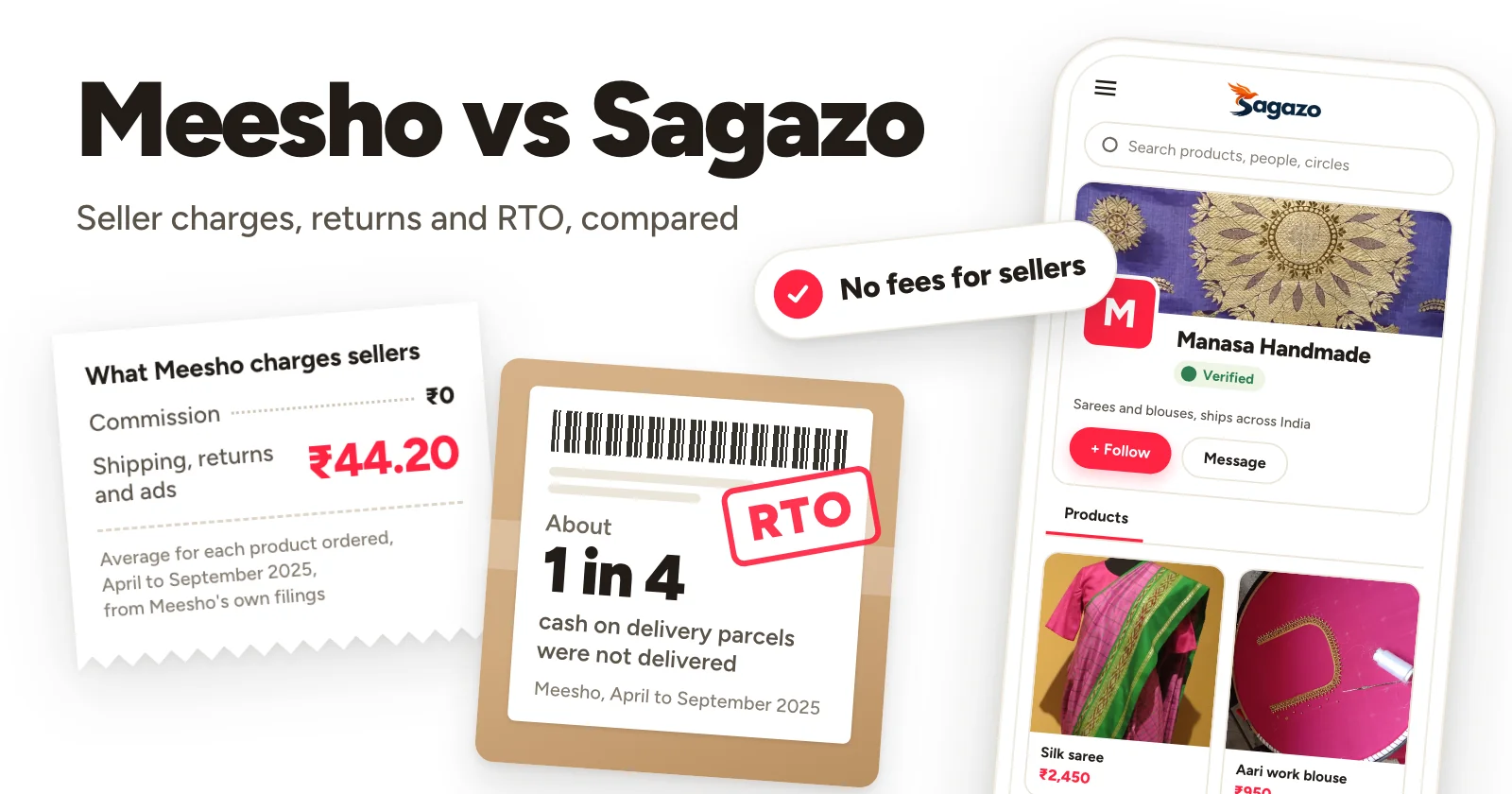
The costs come out of each sale instead. Commission, closing fees, shipping deductions and returns take a real share of the price, which we worked out line by line in what marketplaces really charge sellers in India. Meesho charges no commission, and it is no longer the only one. Amazon and Flipkart now charge none on most products under ₹1,000, and Flipkart charges none on fashion at any price. The other deductions still apply. And the buyer belongs to the marketplace, not to you. You do not get their number, and they rarely remember your shop's name.
A shop page on a social commerce app
A social commerce app gives you a shop page with its own link, a cart and a checkout, and puts your products in front of people scrolling a feed. On Sagazo the shop page is free, and your products show up in the shop and in the feed, where new buyers can find them. You do not need a website, a domain or a developer, and there is no commission on what you sell, as we explain in Sagazo's zero commission model.
You can share your shop link on WhatsApp and put it in your Instagram bio, so the orders that used to happen in chat happen on a page with a cart instead.
Do you need GST to sell without a website?
The GST rules are the same whether you sell on a website, on WhatsApp or on an app. If you sell only within your own state and stay under your state's yearly limit, you can sell on a marketplace or an app without GST registration, using a free enrolment number instead. Selling to other states needs GST registration. The rules are explained in plain words in do you need GST to sell online in India, and the steps for the free number are in how to get a GST enrolment number.
When does a website make sense?
A website is worth having once you have regular customers. If buyers search for your shop by name, a website is where they should land, at an address of your own that no app can change. It also helps when you sell something that needs a long explanation, like custom orders, or when you want to run ads to a page you control. Once buyers search for your shop by name, registering your shop name as a trademark also starts to be worth the fee.
Before that, the money is better spent on stock and photos. And a website is something you add to WhatsApp, Instagram or a shop page, not something you replace them with. Even large brands keep all of them going.
You lose nothing by waiting, because your customers on WhatsApp and Instagram, your photos and your product list all move with you whenever you decide to build one.
Selling on Sagazo
If you want a shop page with its own link today, without paying for a domain or a store plan, you can open one on Sagazo. There is no commission and no listing fee, so a saree you sell for ₹700 pays you ₹700. Tell us about your shop on the become a seller page and we will help you get set up.
Once your shop is open, the help centre covers setting up your storefront.