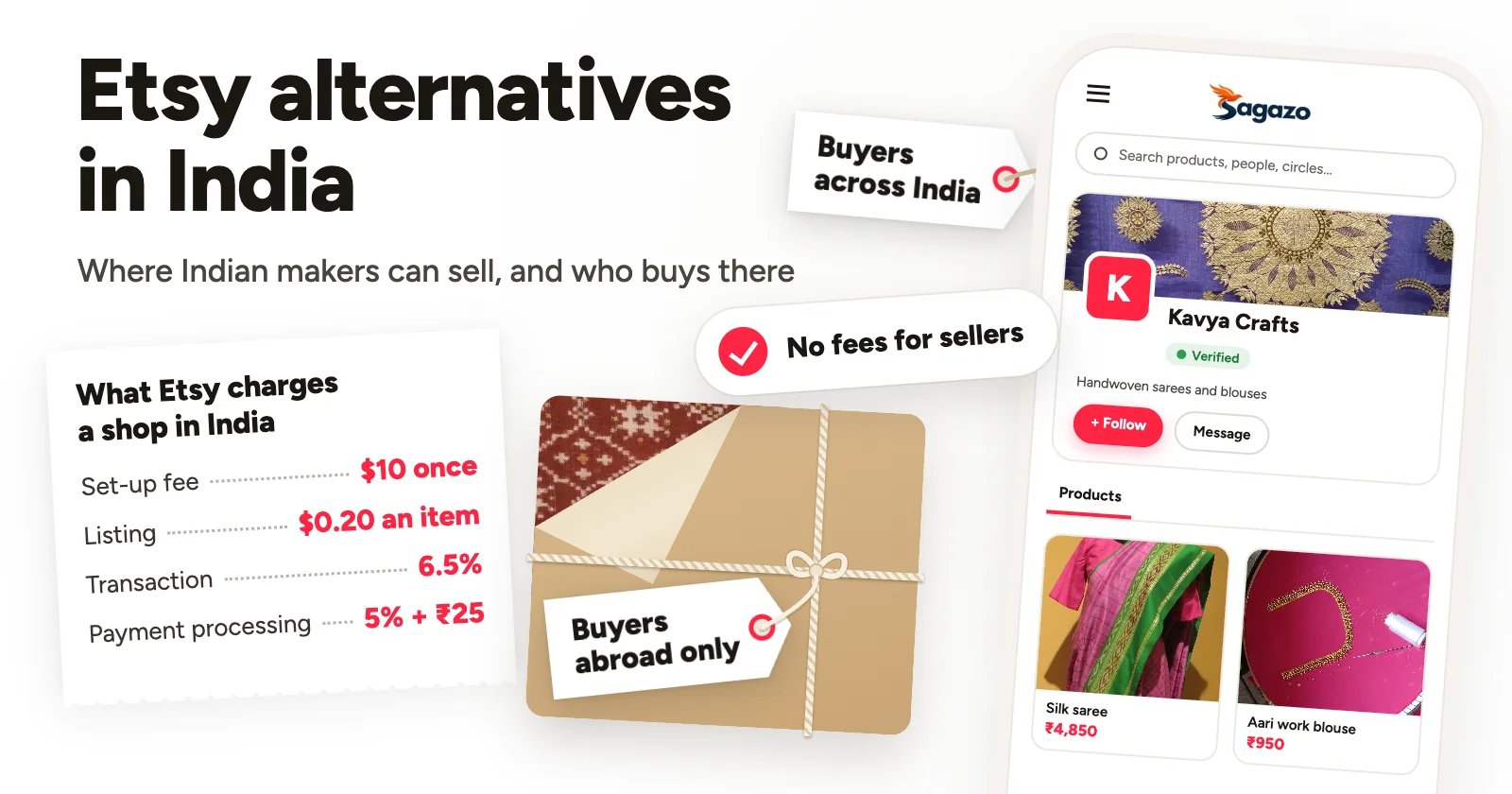
The main Etsy alternatives in India for handmade sellers are Amazon's Karigar programme, Flipkart Samarth, the government's India Handmade marketplace, Meesho and Sagazo. On Sagazo your shop gets its own page and link, and your work appears in a feed that people across India scroll. To reach buyers abroad without Etsy, you can sell through Amazon Global Selling, eBay or your own website. Etsy takes new shops from India again, but since 3 June 2024 a shop based in India can sell only to buyers outside India.
This post compares them, with what each one charges a seller, as of November 2026. Sagazo is ours, and it serves buyers in India only, the buyers an Etsy shop in India can't reach.
Etsy alternatives in India at a glance
| Where to sell | Who buys | What it charges a seller | What you need |
|---|---|---|---|
| Etsy, for comparison | Abroad only, for a shop in India | US$10 to open, US$0.20 a listing, 6.5% + 5% + ₹25 a sale | GSTIN, PAN, Payoneer |
| Amazon Karigar | India | A referral fee of 8% or less, none under ₹1,000 in 1,800+ categories, plus other fees | New sellers only; GSTIN, PAN |
| Flipkart Samarth | India | 0% for six months, then 5%, plus a fixed fee | Handcrafted work; GST certificate |
| India Handmade | India | No commission; the Ministry pays the courier for now | Handloom, Handicraft or Pehchan card; GSTIN or enrolment number |
| Meesho | India | No commission; a shipping charge on each order, a return fee | GSTIN or enrolment number |
| Sagazo | India | No commission, listing fee or monthly charge | The shop form, then a call or message to verify it |
| Amazon Global Selling | 18 Amazon sites abroad | In North America, US$0.99 an item or US$39.99 a month, plus mostly 8% to 15% | IEC, ID, a card that works abroad |
| eBay | Abroad | 13.6% of most sales, maybe an international fee | An account; payouts to a bank or Payoneer |
| Your own website | Buyers you find yourself | Shopify Basic at ₹1,499 a month paid yearly, plus 2% an order | A payment company |
A GSTIN is a GST number, and an IEC is the code you need to export. On India Handmade, Meesho and Sagazo, a seller on the free GST enrolment number sells only inside their own state.
Can you still sell on Etsy from India?
Yes, but only to buyers outside India. Etsy stopped new sellers in India from opening shops in November 2023. On 3 June 2024 the shops already open lost their sales to buyers in India, along with the Razorpay payments they used. To keep selling abroad, they had to move to Etsy Payments with a GST number. Etsy later let new shops from India open again. By the end of May 2025, its help page for sellers in India said: "Currently, new shops opened in India can only sell internationally."
Etsy has not left India: buyers in India can still order from Etsy shops in other countries. Shops based in India can't sell to them, not even a digital download.
To open a shop, Etsy asks for your PAN and your GST number (GSTIN). It also wants a debit or credit card, a photo of your ID with a selfie, and an Indian bank account linked to Payoneer, the payments company Etsy pays Indian sellers through. The set-up fee is US$10, paid once. Without a GSTIN, Etsy says it "will suspend your shop and withhold any deposits until you add one", so you can't sell on Etsy from India without GST registration. How to register for GST online goes through the form.
Etsy's rules also ban reselling, including "handicrafts or fair trade items that were not made or designed by the seller", so you can't sell artisans' work that you bought.
How much does Etsy charge Indian sellers?
On a painting that sells for the dollar equivalent of ₹2,000, Etsy keeps about ₹275, on top of the US$10 set-up fee. These are its fees for a shop in India:
- US$0.20 for each listing, whether or not the piece sells. Etsy's India page shows it as ₹19 but bills it in dollars. A listing lasts four months.
- A transaction fee of 6.5% of the price, and of any postage or gift wrap you charge.
- A payment processing fee of 5% + ₹25 on each order, postage included.
- A regulatory operating fee of 0.05%.
- 15% of the order, up to US$100, when the buyer came from an ad Etsy ran on another website. You can turn those ads off until your shop sells US$10,000 in a year. After that the fee is 12%, and the ads stay on.
On the ₹2,000 painting, that is ₹19 for the listing, ₹130 in transaction fee, ₹125 for processing (5% is ₹100, plus ₹25) and ₹1 in regulatory fee, ₹275 in all. If an ad brought the buyer, add ₹300, for ₹575. If you charge the buyer ₹1,000 for postage, about ₹115 of that goes in fees too.
Etsy pays only in US dollars, to your Payoneer account, every Monday. Payoneer changes the money into rupees and sends it to your bank, usually in 2 to 5 working days. Etsy puts Payoneer's fee at "typically up to 3%", which on the ₹1,725 left from the painting is up to about ₹52. Etsy holds back 0.5% of each sale as TCS and 0.1% as TDS, about ₹10 and ₹2 here. Those are taxes you claim back when you file your returns, not fees. Etsy can also hold back part of your money, for example after your first sale. Its payments policy allows up to 180 days, and its help page says most sellers get it back within 90 days.
How can you sell handmade products abroad without Etsy?
You can sell abroad through Amazon Global Selling, eBay or your own website. Each parcel is an export, with the same paperwork as an Etsy order.
You need an Importer Exporter Code (IEC), which is your PAN used as a 10-character code. You apply online at dgft.gov.in and pay ₹500 once, then confirm its details online every April to June, or it is switched off until you do.
Expect to register for GST too: the law counts a sale abroad as a sale to another state, and Etsy and India Post's export desks both ask for a GSTIN. Exports carry no GST. To send them without paying the tax first, you file a Letter of Undertaking (LUT) online before your first export each financial year.
By December 2025 India Post had 1,013 export desks, called Dak Ghar Niryat Kendras, at post offices in 762 districts. They handle the export paperwork online and pick parcels up free, and you register once on the Dak Ghar Niryat Kendra portal. India Post's International Tracked Packet pays at most ₹1,000 if a parcel is lost or damaged. Couriers carry exports too, and since 1 April 2026 there is no limit on the value of each courier parcel.
The US ended duty-free entry for parcels worth up to US$800 on 29 August 2025, and India Post stopped booking most parcels there from 25 August to 15 October 2025. When bookings started again, India Post began collecting the US duty from the sender at the time of booking. Etsy's Purchase Protection covers an order to a US buyer only when it is sent with the duty paid.
Amazon Global Selling lets you list on 18 of Amazon's marketplaces abroad, without an Amazon.in account. You need ID, a card that works abroad, your IEC and an AD code from your bank. In North America it costs US$0.99 an item sold or US$39.99 a month, plus a referral fee of mostly 8% to 15%.
eBay takes sellers from India for exports and pays out to a bank account or to Payoneer. It charges 13.6% of most sales, and it may add an international fee.
Your own website, such as a Shopify store, can sell anywhere, but you have to find the buyers yourself. Shopify Basic costs ₹1,499 a month paid yearly, and Shopify takes 2% of each order on top of your payment company's fee. Our post on whether a small seller needs a website works out what that costs.
Can you sell handmade products on Amazon India?
Yes. Amazon.in has a programme for handmade goods called Karigar, and individual artisans and weavers, NGOs, cooperatives and government emporiums can apply on Amazon's Karigar page. It takes new sellers only. Your products must not be machine made, and you need GST registration and a PAN.
Karigar lowers the referral fee, Amazon's commission on each sale, to 8% or less, depending on the category. Since 16 March 2026 Amazon.in charges no referral fee on items under ₹1,000 in more than 1,800 categories, so the lower rate matters from ₹1,000 up. On the ₹2,000 painting it is ₹160 at most. Amazon's other fees still apply, and what Amazon, Flipkart and Meesho charge sellers goes through them. Approved makers get help photographing and listing their products, and a place in Amazon's Karigar store.
Does Flipkart have a programme for artisans?
Yes, Flipkart Samarth. It is open to sellers of handcrafted products, made "entirely by hand, using traditional or non-electrical machines, and majorly with natural materials". Artisans and weavers with an artisan or weaver card or a Pehchan ID qualify, as do non-profit companies and entrepreneurs with a disability.
Samarth charges 0% commission for six months, then 5% while your sales stay under ₹1 crore a year, and Flipkart helps you list up to 100 products. You need a GST registration certificate. Flipkart already charges every seller 0% commission under ₹1,000, and on fashion at any price, so Samarth matters most for dearer pieces outside fashion. The ₹2,000 painting pays nothing for six months and ₹100 after that, plus Flipkart's fixed fee for each order.
Samarth's page on Flipkart's seller site is gone, but the programme still runs. In January 2026 Flipkart announced its eleventh Samarth sale, and in February it partnered with the Kerala government to bring artisans onto Flipkart.
Is there a government website to sell handmade products?
Yes. India Handmade is the Ministry of Textiles' marketplace for handloom and handicraft makers, launched in 2023. It charges no commission, and for now the Ministry pays for the courier, which India Handmade picks. There is no cash on delivery, and you are paid 7 days after an order is delivered, minus TDS and TCS. You register with a Handloom, Handicraft or Pehchan ID card, your PAN, a bank account, and a GSTIN or a GST enrolment number. Getting the free GST enrolment number takes about ten minutes on the government portal.
Tribes India works differently: tribal artisans sell their work to TRIFED, which sells it in Tribes India shops and online. GeM is where government offices buy, not households. ONDC is a network you join through a seller app, which lists your products and pays you. The PM Vishwakarma scheme for artisans helps registered makers get listed on both.
Can you sell handmade products on Meesho?
Yes. Meesho takes no commission, and you can join with a GSTIN or the free enrolment number. You pay its shipping charge on each order, a fee when a buyer returns a product, and ads if you choose them. The catch for handmade work is price. The average product ordered on Meesho cost ₹265.50 in April to September 2025, and the ₹2,000 painting costs more than seven times that. We set out Meesho vs Sagazo for sellers charge by charge.
Can you sell on iTokri, GoCoop or other craft websites?
Some Indian craft websites take makers, but they choose whose work they sell. iTokri picks makers from catalogues with photos and prices sent to it by email, and it holds the stock itself. If it doesn't reply within 7 days, take that as a no. GoCoop is now GoSwadeshi, a marketplace for handlooms and crafts, and we found no sign-up page for sellers on it. Okhai has a partner form for craft brands. We found nothing on their sites about whether any of the three buys your pieces outright or pays you when they sell, so ask before you send stock.
DIYbaazar is free to join, with GST optional, and adds its 15% commission and the delivery charge on top of your price.
Is there an Indian version of Etsy?
Not exactly. India Handmade is the government's marketplace for handloom and handicraft makers, and Sagazo, which we make, is a social commerce app where makers and small sellers open shops. It serves buyers in India only: you sign in with an Indian mobile number, and orders ship within India. So Sagazo can't reach your buyers abroad, but it reaches the buyers at home that an Etsy shop in India can't.
Your shop gets a page with its own link, sagazo.com/shop/your-shop-name, to share on WhatsApp or Instagram. Handmade work has its own category, handicrafts and handmade, and your products also appear in the feed between people's posts, where buyers who weren't searching come across them. You can post a photo of a piece being made, and people can follow your shop and message you.
Sagazo charges sellers no commission, no listing fee and no monthly charge, and opening a shop is free, so the ₹2,000 painting pays you ₹2,000. How zero commission selling works explains how we can charge nothing. A GSTIN lets you sell anywhere in India, and the free enrolment number lets you sell inside your own state. A person at Sagazo verifies each new shop with a call or a message within 24 hours, before its products show to buyers. Buyers pay online, and there is no cash on delivery. You can post each parcel yourself, and then the courier is your cost, or have Sagazo book the courier, and then the buyer pays the quoted delivery charge at checkout.
Sagazo is new and small, with far fewer buyers than the big marketplaces.
Which Etsy alternative suits your craft?
Start with where your buyers are. If they are abroad and you can manage GST and the export paperwork, Etsy can reach them, and so can Amazon Global Selling, eBay or a website of your own. If they are in India, an Etsy shop based here can't sell to them, so choose by the papers you have and by how you want buyers to find you.
Amazon Karigar and Flipkart Samarth want a GSTIN, and they bring their own shoppers. India Handmade, Meesho and Sagazo also take the free enrolment number for sales in your own state, and whether you need GST to sell online depends on where you ship and how much you sell. India Handmade needs an artisan's ID card, and Meesho's buyers spend little on each product. Sagazo suits a maker who wants a shop page of their own, with buyers who follow it.
You can sell in more than one place at once. If you do, take a one-off piece down everywhere else as soon as it sells, so it can't sell twice. How to sell handmade products online from home covers pricing that pays for your time, photos and packing.
Selling on Sagazo
If you make things by hand and sell to buyers in India, you can list them on Sagazo as well as anywhere else, and there is nothing to pay for doing it. Tell us about your shop on the become a seller page and we will help you get set up.
Once your shop is open, the help centre shows how to add a product and how to share your shop link.
Etsy's fees and rules are from its own help pages and policies, and the other platforms' terms from their own pages, as of November 2026. They change often, so check them before you price anything.